
Review: The House Built on Alligator Bones
An affiliate link is included; there is no additional charge.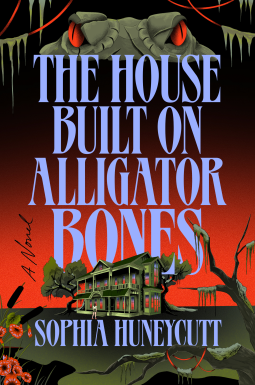
Once I remembered what happened that night… I can decide whether this family is damned.
The House Built on Alligator Bones – Sophia Huneycutt
Release Date: October 6, 2026
★★★★★
Dartrine, or Dart, believes she’s alone after her mother’s death, but then, she hears from the Greers, long-lost wealthy relatives. Excited to meet her extended family, she travels to Amelia Island, Florida to visit her grandmother and aunt in their ancestral home, a Victorian-style mansion known as Greer House. She arrives to find she’s unwittingly entered a competition against an arrogant man named Harrison, heir apparent to the Greer Fine Alligator empire. When she starts working at the family alligator farm, Dart learns that the business has always been plagued by strange occurrences – algae blooming overnight, alligators that only hiss at the Greers, a new roof that springs a leak every week, and soon, things escalate further. Her grandmother believes a legendary alligator, killed by their ancestor, haunts the family business, and Dart thinks there’s a shadowy, angry presence haunting Greer House itself. As she learns more about her family’s legacy, Dart has to choose between continuing violent traditions or finding a new way forward.
The House Built on Alligator Bones asks readers to consider what we owe our family – past, present, and future. It asks how far we’re willing to go to maintain their legacy or break it. Horror is a fantastic genre for exploring these ideas. The lush, Southern Gothic atmosphere was the perfect backdrop for unraveling Dart’s complicated inheritance. I didn’t think anything could make me miss those stifling southern summers, but after reading this, some part of me does. Huneycutt captured so many of the best and worst things about historic towns of the American South – close-knit communities; charming Gilded Age homes; an abundance of beautiful, though occasionally terrifying, natural areas; and the rarely acknowledged dark past lurking beneath it all.
We follow along as Dart recalls her time at Greer House, and her reflections, as they come up, add to the intrigue. Information about Dart’s life and the Greer family history is spread throughout the novel exceptionally well. We return to the same stories several times. In my experience with thrillers, this usually feels like a reminder to the reader rather than a way to further the plot, but it works really well here. Each time, we learn something that further complicates our understanding of the characters and often impacted how I thought future events would play out. It keeps the tension and suspense high because even if you know the basics of a story, there’s always the feeling that it could get much, much worse. It also felt extremely accurate to how families tell each other stories and share different details on every retelling.
The Greer family sits at the center of this novel, and in that regard, it’s a story about generational trauma, a theme I find incredibly interesting. Dart provides a unique perspective as a woman whose life has been defined by a matriarchal family she didn’t know existed, so we’re speculating and learning about the Greers’ and their past alongside Dart instead of waiting for her to share it with us. The characters are complex and evocative. Each of them experienced and recalls the same people and situations differently, so again, you may have an idea of who people are but hearing a story again will inevitably change your perspective on everyone involved. In short, it’s an unflinching look at how the past hovers over our lives, how it’s a layered thing that looks different depending on who’s in the room.
Dart also has postural orthostatic tachycardia syndrome, or POTS. POTS is a chronic condition that can lead to dizziness, shortness of breath, and fainting. Symptoms are triggered by everyday activities like standing quickly, walking long distances, and being in a warm environment. POTS doesn’t have a lot of representation in fiction, and though I don’t have POTS, I felt it was well done. Huneycutt avoids a lot of common issues in disability representation – such as the disability being a character’s primary personality trait, played for laughs, or a plot convenience, among others. Dart’s symptoms aren’t sensationalized, and they don’t make her incompetent. It’s just a normal part of life that she manages throughout the novel, as chronic conditions are.
The House Built on Alligator Bones is a gripping, Southern Gothic horror novel with an eerie atmosphere, thought-provoking themes, and propulsive writing. I flew through it and can see myself doing several rereads in the future. I can’t recommend this novel enough. It’s a stunning debut, and I can’t wait to see what Sophia Huneycutt does next.
Content warnings: ableism, animal cruelty and death, death (incl. child, parent), gore, intrusive thoughts, misogyny, violence